

Many businesses today are experimenting with AI tools.
They use AI to write captions, generate images, summarize documents, create blog drafts, answer customer questions, or prepare reports. This is a good starting point. AI tools can save time and help teams work faster.
But after the first phase of experimentation, many businesses face a new problem.
They are using many AI tools, but their work is still scattered.
AI tools help with tasks. AI systems help improve workflows.
For long-term business value, companies need more than individual AI tools. They need AI systems that connect with how work actually happens.
What Are AI Tools?
AI tools are individual applications that help complete specific tasks.
For example, an AI writing tool can help create a blog draft. An AI design tool can generate images. An AI chatbot can answer customer questions. An AI meeting tool can summarize calls.
AI tools are useful because they are easy to start with and solve immediate problems.
These tools can improve productivity, especially for small teams. They reduce the effort required for repetitive or time-consuming tasks.
But AI tools usually work in isolation.
They may help create one output, but they do not always manage what happens before or after that task.
For example, an AI tool may write a LinkedIn post. But it may not know whether the post is approved, when it should be published, who needs to review it, which campaign it belongs to, or how it performed after publishing.
That is where the limitation begins.
What Are AI Systems?
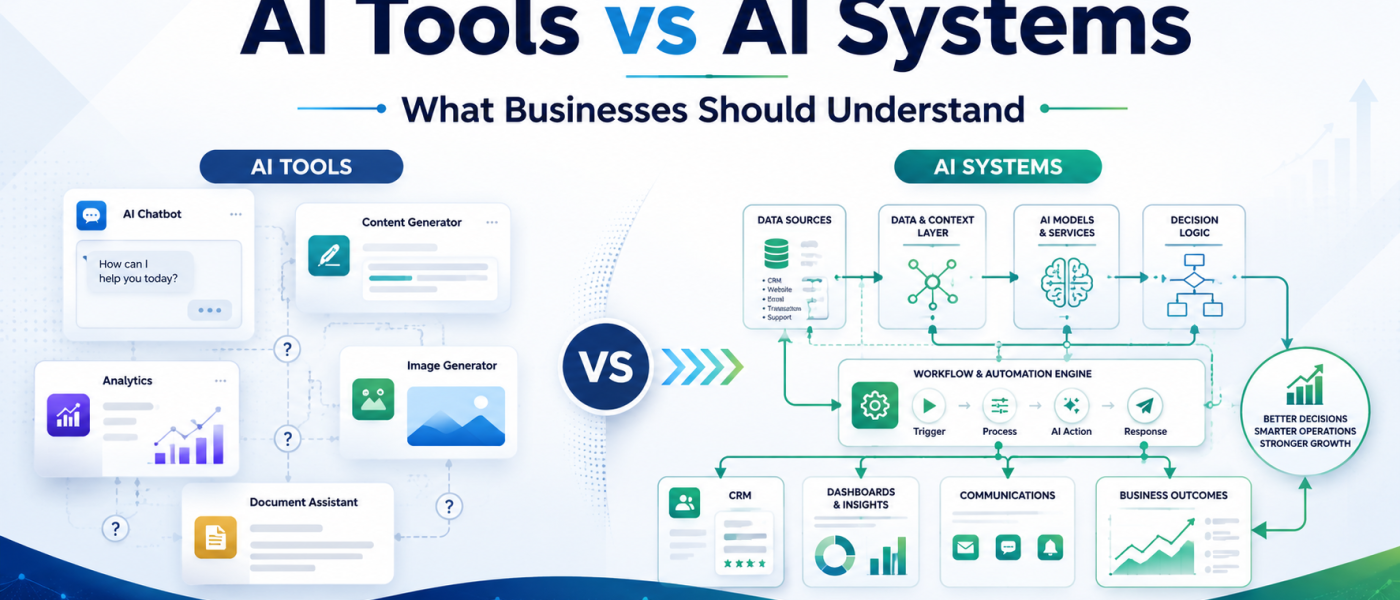
AI systems are connected workflows that use AI to support a full business process.
An AI system does not only generate an output. It helps move work from one stage to another.
The difference is simple.
An AI tool may create a caption.
An AI system can plan the post, draft the caption, track approval, schedule publishing, and include the result in a report.
AI systems are more valuable because they bring structure, visibility, and repeatability into business operations.
They help teams reduce manual coordination and manage work from one connected process.
AI Tools vs AI Systems: The Key Difference
| AI Tools | AI Systems |
| Help with individual tasks | Support complete workflows |
| Usually work separately | Connect multiple steps |
| Useful for quick outputs | Useful for repeatable execution |
| Depend on manual coordination | Reduce manual coordination |
| Improve productivity for one task | Improve productivity across a process |
| Limited visibility | Better workflow visibility |
| Good for experimentation | Better for business implementation |
AI tools are good for starting with AI.
AI systems are better for scaling AI inside a business.
The Problem with Too Many AI Tools
Using too many AI tools without a system can create a new type of confusion.
Instead of reducing complexity, it can add more layers to the work.
A business may have one tool for writing, another for design, another for customer replies, another for reporting, and another for scheduling. But if these tools do not connect, the team still has to manage everything manually.
This creates problems such as:
- Duplicate work
- Scattered data
- No single source of truth
- Delayed approvals
- Missed follow-ups
- Inconsistent output quality
- Poor tracking
- Limited accountability
- Confusion between teams
In this situation, AI may help with small tasks but fail to improve the larger business process.
That is why the next stage of AI adoption is not only about using more tools. It is about building better systems.
Why AI Systems Create More Business Value
AI systems create stronger business value because they are connected to workflows.
They help businesses not only complete tasks faster, but also manage work better.
Here are some ways AI systems create value.
1. Better Workflow Control
AI systems help teams understand what is planned, what is pending, what is approved, and what needs action.
This improves control and reduces confusion.
2. Faster Execution
When steps are connected, work moves faster. Teams do not need to manually remind each other for every update.
3. Improved Consistency
A system helps ensure that important tasks are repeated regularly, such as posting content, sending follow-ups, publishing blogs, or preparing reports.
4. Better Visibility
Managers get a clearer view of tasks, leads, campaigns, reports, and performance.
5. Less Manual Coordination
AI systems reduce dependency on spreadsheets, chat reminders, and manual status updates.
6. Scalable Operations
As the business grows, systems make it easier to manage more work without creating more chaos.
How Businesses Can Move from AI Tools to AI Systems
Businesses do not need to automate everything at once.
A better approach is to start with one workflow.
For example:
- Content planning workflow
- WhatsApp lead follow-up workflow
- Blog publishing workflow
- Customer support workflow
- Sales reporting workflow
- Internal task tracking workflow
Once one workflow becomes structured, the business can expand automation gradually.
FAQs
What is the difference between AI tools and AI systems?
AI tools help with specific tasks, such as writing, image generation, summarizing, or replying. AI systems support complete workflows by connecting multiple tasks and improving execution.
Are AI tools enough for businesses?
AI tools are useful for starting with AI, but they may not be enough when a business needs structured workflows, lead tracking, reporting, approvals, and consistent execution.
Why do businesses need AI systems?
Businesses need AI systems to reduce manual coordination, improve visibility, manage workflows, and scale operations more efficiently.
Can small businesses use AI systems?
Yes. Small businesses can start with simple AI systems for lead follow-ups, content planning, blog workflows, reporting, or customer communication.
Conclusion
AI tools and AI systems both have value, but they serve different purposes.
AI tools help businesses complete individual tasks faster. They are useful for writing, designing, summarizing, researching, and creating quick outputs.
AI systems help businesses manage complete workflows. They connect tasks, reduce manual coordination, improve visibility, and make execution more consistent.
For businesses starting with AI, tools are a good first step.
But for businesses that want long-term value, AI systems are the next step.
The real opportunity is not just using more AI tools.
The real opportunity is building smarter business workflows with AI.