



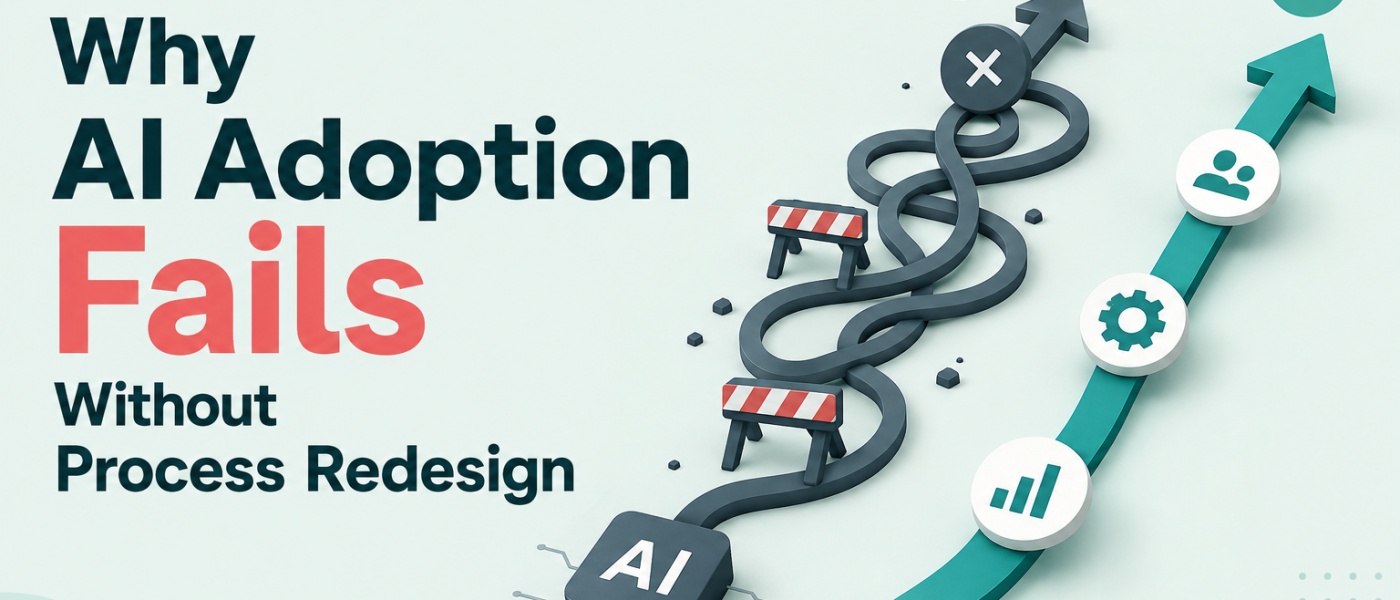
Many businesses are investing in AI, but not every business is seeing real value from it.
AI adoption fails when businesses treat it as a software upgrade instead of a process change.
The real value of AI comes when organizations redesign how work moves across teams, systems, approvals, data, and decisions.
In short:
AI does not fix broken processes. It exposes them.
AI Adoption Is Growing Fast, But Scaling Is Still Difficult
AI adoption has increased sharply across industries. Stanford HAI’s 2025 AI Index reported that 78% of organizations used AI in 2024, compared with 55% in 2023. Corporate AI investment also reached $252.3 billion in 2024, showing that businesses are taking AI seriously. (Stanford HAI)
But adoption and impact are not the same.
McKinsey’s 2025 State of AI report found that nearly nine out of ten organizations are regularly using AI, but the transition from pilots to scaled business impact remains uneven. The same report notes that AI high performers are more likely to redesign workflows and push for transformational change, not just deploy tools. (McKinsey & Company)
This is the key problem.
Many companies are using AI. Fewer are redesigning work around AI.
Why AI Fails Without Process Redesign
AI usually fails when it is added on top of existing inefficiencies.
For example, if a sales team already has poor lead tracking, adding an AI chatbot will not automatically improve conversions. If a marketing team has no approval workflow, using AI to generate more content may only increase the backlog. If customer data is scattered, AI will struggle to give reliable insights.
The failure is not always technical. Often, the problem is operational.
Businesses try to automate tasks without first asking:
- Who owns this process?
- Where does the workflow start and end?
- What data is needed?
- What approvals are required?
- What should happen after AI gives an output?
- Who reviews the final decision?
- How will success be measured?
Without these answers, AI becomes another disconnected tool.
AI Cannot Fix Unclear Ownership
One common reason AI adoption fails is unclear ownership.
Many AI projects start with excitement, but no one clearly owns the outcome. IT may own the technology. Business teams may own the process. Data teams may own the information. Compliance may own the risk. But if these teams are not aligned, the project slows down.
AI needs cross-functional ownership.
For example, an AI customer service project is not only a technology project. It involves customer support, IT, data, legal, compliance, training, and operations.
Without process redesign, every department sees only its own part.
With process redesign, the organization defines the full journey from customer query to resolution, escalation, reporting, and improvement.
That is where AI starts becoming useful.
AI Makes Bad Workflows Faster
Many businesses assume automation automatically improves efficiency.
But automating a bad workflow can make the problem faster.
If approvals are unclear, AI-generated work will still wait for approval.
If data is messy, AI outputs will be unreliable.
If teams do not know what action to take next, AI summaries will not create impact.
If follow-ups are not tracked, AI-generated reminders may still be ignored.
AI should not be used to speed up broken processes.
Before implementation, businesses should simplify the workflow.
Only then should AI be added.
AI Tools Alone Create More Fragmentation
Many employees already use AI tools for writing, research, summaries, ideas, and reporting. This can improve individual productivity.
But when every team uses different tools without a common process, the organization becomes more fragmented.
The business still lacks one view of work, data, approvals, and outcomes.
This is why organizations are moving from standalone AI tools to AI-powered workflows and systems. The goal is not only to produce faster outputs, but to make the entire process more visible, repeatable, and measurable.
AI Needs Better Data Foundations
AI depends on data quality.
If data is incomplete, outdated, duplicated, or scattered, AI cannot produce reliable results.
This is especially important in industries like finance, insurance, healthcare, education, and real estate, where decisions depend on accurate customer, transaction, service, or compliance information.
Before scaling AI, businesses need to redesign how data is captured, stored, cleaned, accessed, and reviewed.
AI Requires Human-in-the-Loop Design
Another reason AI adoption fails is over-automation.
Some businesses expect AI to make decisions independently. But in most business settings, especially regulated or customer-sensitive areas, AI should support humans, not replace them.
A better model is human-in-the-loop AI.
This means AI can draft, classify, summarize, recommend, or automate repetitive steps, while humans review, approve, and make final decisions.
Process redesign defines where AI acts and where humans intervene.
Without that clarity, businesses risk errors, bias, poor decisions, and loss of trust.
What Process Redesign Looks Like Before AI
Before implementing AI, businesses should map the workflow clearly.
A practical redesign process can look like this:
- Identify the workflow that needs improvement
- Map every step from start to finish
- Find delays, duplication, and manual effort
- Remove unnecessary steps
- Define data inputs and outputs
- Set human review points
- Decide where AI can assist
- Connect AI output to the next action
- Track performance with clear metrics
- Improve the workflow over time
This approach makes AI implementation more practical.
Instead of forcing AI into the business, the business redesigns the process so AI can create measurable value.
Key Trend: From AI Experiments to AI Execution
Businesses are moving from:
AI pilots → AI workflows
AI tools → AI systems
AI experiments → AI operating models
AI usage → AI outcomes
This shift matters because AI value depends less on the tool itself and more on how well it is connected to work.
FAQs
Why do AI projects fail?
AI projects often fail because of unclear ownership, poor data quality, weak governance, broken workflows, lack of human review, and no clear business outcome.
What is process redesign in AI adoption?
Process redesign means rethinking how work moves across people, systems, data, approvals, and decisions before adding AI into the workflow.
Why are AI tools not enough?
AI tools help with individual tasks, but they do not automatically improve full business workflows. Businesses need connected processes to get measurable value.
What should businesses do before implementing AI?
Businesses should map workflows, identify bottlenecks, clean data, define human review points, clarify ownership, and set measurable success metrics.
How should AI success be measured?
AI success should be measured through business outcomes such as time saved, faster response, better accuracy, improved visibility, reduced manual work, and stronger customer experience.