



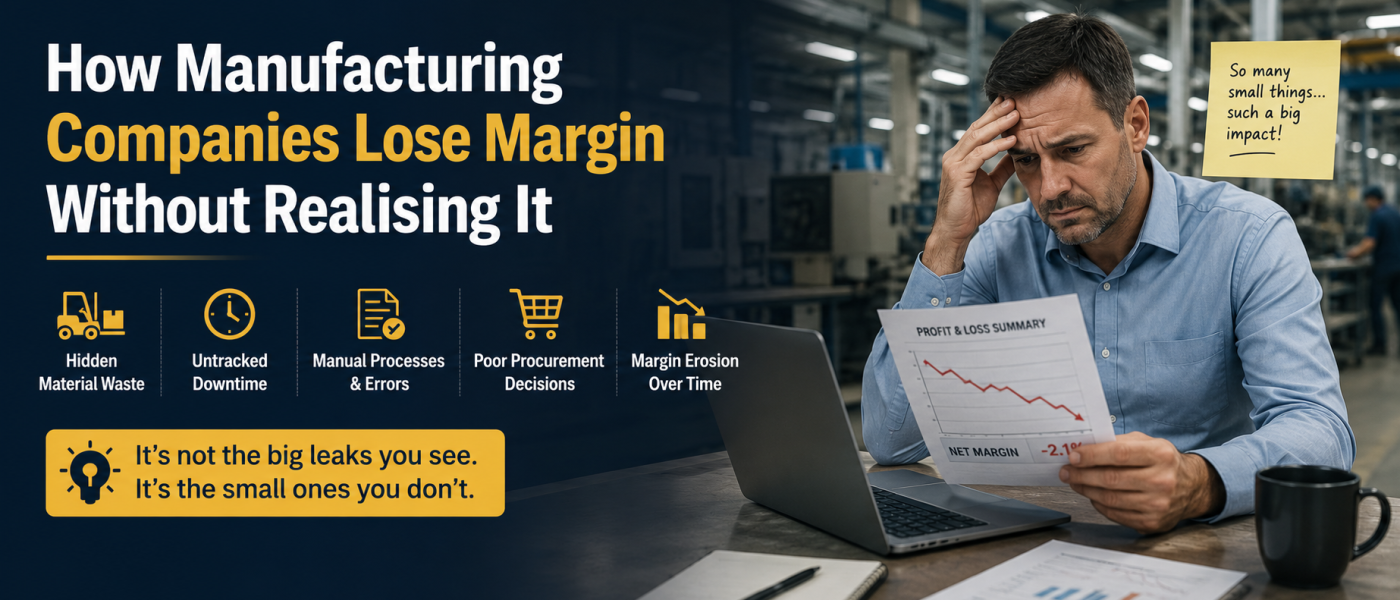
Most manufacturing companies do not lose margin in one dramatic event. They lose it in small, repetitive leaks: a machine that sits idle for too long, a batch that needs rework, a quotation that moves one day late, a senior engineer who keeps answering the same question, a maintenance issue that should have been predicted, not repaired after failure.
The problem is not that these leaks are invisible to operations teams. The problem is that they are invisible to the profit and loss statement until they have already become expensive.
The scale can be surprisingly large. Siemens estimates that unplanned downtime now costs the world’s 500 biggest companies 11% of revenues, or about $1.4 trillion, and says a heavy industry plant can lose about $59 million a year. Deloitte adds that poor maintenance strategies can reduce an asset’s productive capacity by 5% to 20%, while unplanned downtime costs industries an estimated $50 billion annually.
The hidden margin leakage map
| Margin leak | What it looks like | Research signal | Why it matters |
| Unplanned downtime | Machines stop, teams wait, deliveries slip, overtime rises | 11% of revenues lost by the world’s 500 biggest companies; heavy industry plant at $59 million a year | Direct margin destruction |
| Weak maintenance discipline | Reactive repairs, repeat breakdowns, low equipment availability | Productive capacity can fall by 5% to 20%; downtime costs industries about $50 billion yearly | The plant works below potential |
| Scrap and rework | Quality failures discovered too late | One manufacturer cut cost of nonquality by about 30% | Poor quality becomes a profit leak |
| Slow handovers and decisions | Quotations, approvals and production decisions stall | 1% service-level improvement plus 1% less downtime can lift revenue by 0.2% | Small changes compound quickly |
| Knowledge concentration | Senior people become the memory of the business | Agentic AI can capture institutional knowledge from retiring employees | Margin leaves when knowledge leaves |
Why manufacturing leaders miss these leaks
The first reason is that the losses arrive in fragments. A 15-minute delay here, a small rework there, one extra approval cycle, one missed handoff, one expediting fee, one quality rejection. None of these feels dramatic enough to trigger a board-level discussion. The second reason is that many plants measure output, but not friction. They track production, dispatch and sales, but they do not always measure the cost of waiting, rework, searching, chasing and redoing. The third reason is cultural: many manufacturers still treat waste as a normal cost of doing business. If the machine is running, the plant is fine. If orders are shipping, the process is working. But that is a dangerous assumption.
The five biggest sources of margin erosion in manufacturing
1) Downtime that looks normal.
2) Poor quality that gets reclassified as part of the process.
3) Slow decisions that quietly reduce throughput.
4) Knowledge concentrated in too few people.
5) Manual coordination that adds hidden labour cost.
What this looks like in rupees
| Leakage source | Illustrative annual impact on a ₹10 crore company |
| Downtime and micro-stoppages | 1.5% = ₹15 lakh |
| Scrap and rework | 1.0% = ₹10 lakh |
| Delayed quotations and approvals | 1.0% = ₹10 lakh |
| Manual follow-ups and coordination | 0.5% = ₹5 lakh |
| Knowledge loss and repeat errors | 0.5% = ₹5 lakh |
| Total | 4.5% = ₹45 lakh |
Why AI is now a margin recovery tool, not a buzzword
The AI conversation becomes meaningful only when it is tied to business outcomes. PwC India says its 3A2I framework can help MSMEs overcome readiness constraints and translate AI adoption into time-bound, measurable value. The World Economic Forum’s 2025 playbook for small businesses also says AI adoption can significantly increase shopfloor productivity and revenue generation for MSMEs. McKinsey adds that generative AI has the potential to contribute $2.6 trillion to $4.4 trillion annually across the use cases it studied.
| AI use case | Margin impact |
| Predictive maintenance | Fewer breakdowns, less downtime, higher asset utilisation |
| Quality inspection and vision systems | Lower scrap, fewer defects, less rework |
| Quotation and order intelligence | Faster response times and better conversion |
| Production handover assistants | Fewer missed actions and less dependency on memory |
| Knowledge capture systems | Reduced senior dependency and faster onboarding |
| Procurement and supplier intelligence | Lower expediting cost and fewer stock surprises |
Deloitte’s 2026 outlook says 80% of manufacturing executives surveyed plan to invest 20% or more of their improvement budgets in smart manufacturing initiatives, and it highlights agentic AI as a way to improve productivity, capture institutional knowledge and maximise uptime.
Conclusion
Manufacturing companies usually do not lose margin because of one bad month. They lose it because the business has too many small friction points that nobody has fully priced. Downtime, scrap, rework, delay and knowledge loss are not isolated operational nuisances. They are margin leaks.
That is why AI in manufacturing should not be pitched as a futuristic upgrade. It should be positioned as a practical way to recover lost profit from the workflows, assets and decisions that already exist.
For manufacturers who feel busy but not meaningfully more profitable, the answer is rarely work harder. It is usually find the leakage, fix the process, and use intelligence where the margin is escaping.
References and source credit
Siemens, The True Cost of Downtime 2024
Deloitte, Asset Optimization: Predictive Maintenance
McKinsey, Reimagining operational resilience
McKinsey, The Great Remake: Manufacturing for modern times
PwC India, Unlocking the AI Edge for MSMEs
SIDBI, Understanding Indian MSME sector: Progress and Challenges
EY India, How can manufacturing and MSMEs grow faster with digital transformation
World Economic Forum, Transforming Small Businesses: An AI Playbook for India’s MSMEs